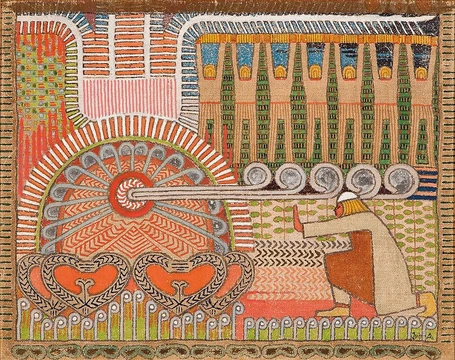
Hou Yi
Mythological Chinese archer who shot down nine suns.
Hou Yi, also known as Shen Yi or simply Yi, is a mythological Chinese archer often given the title 'Lord Archer.' He is depicted variously as a god of archery, a xian descended from heaven, half-divine, or fully mortal. His wife, Chang'e, is one of the lunar deities. Hou Yi is central to myths involving the shooting of ten suns and the slaying of mythical beasts, and his story appears in both legendary and historical contexts.
- also known as
- Shen Yi, Yi
- title
- Lord Archer
- field
- Mythology, archery
- known for
- Shooting down nine of ten suns, slaying mythical beasts, obtaining the pill of immortality
- spouse
- Chang'e (lunar deity)
Lore & Background
The Chu Ci records that the Emperor sent Hou Yi to reform the people of Xia, but he became arrogant, killed Hebo (the god of the Yellow River), and took Hebo's wife Luoshen. In classical historical sources, Hou Yi is depicted as a tribal leader who attacked the Xia dynasty during King Taikang's reign, occupying the capital Zhenxun. He was later deposed by his lieutenant Han Zhuo. Recent research suggests the legend of shooting ten suns may have originated from a miswriting of Hou Yi shooting Xiang.
Reader's Guide
Hou Yi's significance lies in his dual role as both a heroic archer and a cautionary figure. His most famous feat—shooting down nine of ten suns—establishes him as a savior of humanity, a theme echoed in his slaying of multiple mythical beasts that plagued the world. Yet his story also contains darker turns: he becomes a tyrant in some versions, kills a god, and loses his wife to the moon after she consumes the immortality pill. This complexity makes him a rich figure in Chinese mythology, embodying both divine aid and human fallibility. His legend is intertwined with the Mid-Autumn Festival, which honors Chang'e's sacrifice. Historically, he is conflated with a tribal leader who disrupted the Xia dynasty, blending myth with early Chinese political history. The ongoing scholarly debate about the origin of the ten-suns myth—possibly a scribal error—adds another layer to his legacy, showing how folklore and historical record can intertwine.
Did You Know?
- Hou Yi is sometimes portrayed as a god of archery or a xian descended from heaven.
- The fallen suns turned into three-legged crows.
- Hou Yi's wife Chang'e became a lunar deity after swallowing the pill of immortality.
- Recent research suggests the legend of Hou Yi shooting ten suns may have originated from a miswriting of Hou Yi shooting Xiang.
More in Mythological hunters 1-24
Spotted an error? Know more?
This is a living reference — every entry is fact-audited, and reader corrections feed straight into our audit queue. Suggest an edit · See this site's audit record