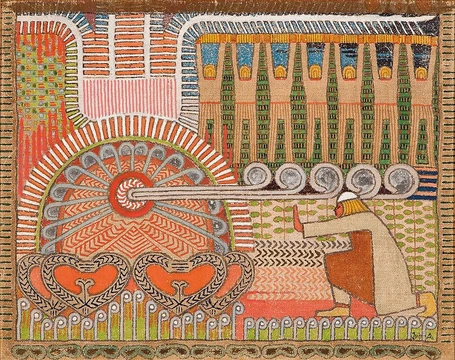
Cyanippus (son of Pharax)
Thessalian hunter whose neglect led to his wife's death.

Wikipedia / Wikimedia Commons
Cyanippus (Ancient Greek: Κυάνιππος, romanized: Kuánippos, meaning 'dark horse') appears in Greek mythology as a minor figure, a hunter from Thessaly in central Greece. He married a woman named Leucone, but his passion for hunting led him to spend long days in the woods, often neglecting her. Suspicious that he might be meeting another woman, Leucone secretly followed him one day, dressed in hunting gear. While Cyanippus was away, his savage hunting dogs caught her scent, mistook her for wild game, and attacked, tearing her apart. When Cyanippus returned and found her mangled body, he was overcome with grief. He built her funeral pyre with the help of his hunting companions, placed her body on it, then killed all his hounds. Finally, he took his own life.
Cyanippus was the son of a man named Pharax; nothing else is known about his mother or family. His story fits a pattern of late Hellenistic love tales in which the male protagonist, blaming himself for his beloved's death, commits suicide after her demise. Other examples include Pamphilus and Eurydice, Anthippe and Cichyrus, and Pyramus and Thisbe—the last of which inspired Shakespeare's *Romeo and Juliet*.
- name
- Cyanippus
- also_known_as
- son of Pharax
- origin
- Thessaly, central Greece
- field
- Mythology
- known_for
- Neglecting his wife Leucone, who was killed by his hunting dogs; his subsequent suicide
- family
- Son of Pharax by an unnamed mother
Lore & Background
Cyanippus, the son of Pharax, was a hunter from Thessaly. He fell in love with the very beautiful Leucone and begged her parents for her hand in marriage, which they granted. After their marriage, Cyanippus frequently spent long hours hunting in the woods, neglecting his wife. He often returned home too tired to speak to her, or sometimes stayed in the woods overnight.
Reader's Guide
The myth of Cyanippus and Leucone is a late Hellenistic love story that follows a motif of a male protagonist who kills himself after his love dies, blaming himself for her unfortunate death. This pattern includes other stories such as Pamphilus and Eurydice, Anthippe and Cichyrus, and Pyramus and Thisbe, the latter of which inspired Shakespeare's Romeo and Juliet. Cyanippus's tale highlights themes of jealousy, miscommunication, and tragic consequences, serving as a cautionary example in classical mythology.
Did You Know?
- Cyanippus's name means 'dark horse' in Ancient Greek.
- His wife Leucone was killed by his own hunting dogs, which mistook her for a wild animal.
- After finding Leucone's torn body, Cyanippus slew all his hounds and then killed himself.
- The story belongs to a pattern of late Hellenistic love stories that includes Pyramus and Thisbe.
Frequently Asked Questions
Who is Cyanippus (son of Pharax)?
Cyanippus is a minor figure in Greek mythology, a Thessalian hunter identified as the son of Pharax. He is best remembered for the tragic fate of his wife, Leucone, which became a cautionary tale about obsession and neglect.
How did Cyanippus's wife Leucone die?
Leucone, suspicious of her husband's long absences, followed him into the woods wearing hunting gear. His savage hounds caught her scent, mistook her for wild prey, and tore her apart before Cyanippus could intervene.
How does Cyanippus's story end?
After returning to the forest and discovering his wife's mangled body, Cyanippus was overcome with grief and killed himself, ending both his life and the brief myth surrounding him.
Why is Cyanippus remembered in Greek mythology?
He serves as a compact tragic example of how a single obsession—here, the relentless pursuit of the hunt—can destroy the people closest to you. Ancient sources cite him as a warning against neglecting domestic bonds for the sake of sport.
What does the name Cyanippus mean?
The Greek name Κυάνιππος (Kuánippos) translates to 'dark horse,' a fitting epithet for a hunter whose life was defined by the wild, untamed world of the Thessalian forests.
More in Mythological hunters 1-24
Spotted an error? Know more?
This is a living reference — every entry is fact-audited, and reader corrections feed straight into our audit queue. Suggest an edit · See this site's audit record