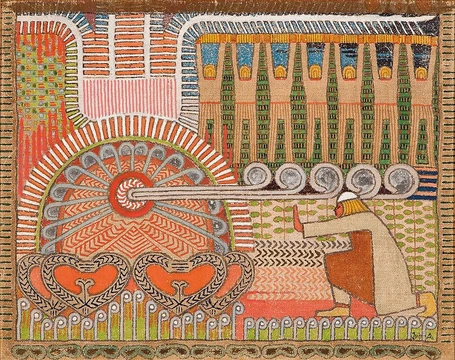
Enos (Book of Mormon prophet)
Nephite prophet who prayed for personal and collective salvation.
Enos is a figure in the Book of Mormon, identified as either a son or grandson of Jacob, a Nephite prophet, and the writer of the Book of Enos. He is thought to have lived in the 5th century BC, composing his record shortly before his death, which occurred 179 years after Lehi’s departure from Jerusalem, or roughly 421 BC. Enos was the third keeper of the Nephite record, a collection of metal plates documenting the spiritual and secular history of the Nephites. His father, Jacob (son of Lehi and brother of Nephi), entrusted him with this record after both Nephi and Jacob had previously maintained it. Enos’s own contribution, the Book of Enos, is a single chapter written in the first person, describing his conversion and his later work as a prophet.
Little is known about Enos’s early life, except that his father taught him “in the nurture and the admonition of the Lord.” Because his account begins with a “wrestle which he had before God” before receiving forgiveness for his sins, some assume he may have been rebellious earlier. President Spencer W. Kimball suggested that, like many sons of good families, he strayed, though the severity of his sins is unknown.
Enos recounts that while hunting in the forest, his “soul hungered,” and he knelt and prayed for forgiveness. His prayer lasted through the day and into the night, until he heard a voice saying, “Enos, thy sins are forgiven thee, and thou shalt be blessed.” After obtaining personal forgiveness, he prayed for his people, the Nephites, and was told they would be blessed according to their diligence in keeping God’s commandments. Strengthened by these revelations, he then prayed for his brethren, the Lamanites, who had become enemies of the Nephites. He received a promise that the Nephite record would be preserved and eventually brought to the Lamanites in the Lord’s due time.
Following his conversion, Enos went forth prophesying to the Nephites. He testifies that the Nephites tried to restore the Lamanites to the true faith but were unsuccessful. He describes the Lamanites as wild, ferocious, and bloodthirsty, while the Nephites were industrious farmers and herders. However, Enos notes that the Nephites were stiffnecked and required continual preaching to prevent them from going down speedily to destruction. At the end of his record, Enos affirms his unshakeable faith in his Redeemer.
Literary critic T
- born
- 5th century BC (approximate)
- died
- Around 421 BC
- field
- Nephite prophet and record keeper
- nationality
- Nephite
- known_for
- Author of the Book of Enos; his conversion experience while hunting; praying for both Nephites and Lamanites
Lore & Background
According to the Book of Mormon narrative, Enos was given charge of the Nephite record by his father, Jacob, son of Lehi and brother of Nephi. Both Nephi and Jacob had previously kept the record. Enos's contribution, the Book of Enos, consists of a single chapter told in the first person, describing his own conversion and ministry. No details of his early life are given except that he was taught by his father 'in the nurture and the admonition of the Lord.' Because Enos begins his story by telling of his 'wrestle which [he] had before God, before [he] received a remission of [his] sins,' it is sometimes assumed that he had been rebellious prior to that time. President Spencer W. Kimball said, 'Like many sons of good families he strayed. How heinous were his sins I do not know, but they must have been grievous.'
Reader's Guide
Enos's significance lies in his representation of a dual message in the Book of Mormon: individual salvation and the gathering of scattered Israel. Literary critic Terryl Givens, in agreement with Grant Hardy, notes that Enos first prays for his own forgiveness and then for the salvation of his people, the Nephites, and later for his enemies, the Lamanites. This pattern exemplifies a broader theme of the book promoting both a personal relationship with Christ and communal redemption. Enos's record also underscores the importance of record keeping among the Nephites, as he was the third in a line of custodians of the metal plates. His ministry involved prophesying to the Nephites, who tried but failed to restore the Lamanites to the true faith. He described the Lamanites as 'wild, and ferocious, and a blood-thirsty people' and the Nephites as 'stiffnecked,' requiring continual preaching to avoid destruction. Following his death, the record passed to his son, Jarom.
Did You Know?
- Enos is the third in a series of Nephite record keepers, following Nephi and Jacob.
- His book consists of a single chapter told in the first person.
- The name 'Enos' means 'mortal man' in Hebrew, similar in definition to 'Adam.'
- Some scholars suggest Jacob may have been Enos's grandfather rather than his father, as Enos never mentions his father by name.
Frequently Asked Questions
Who is Enos (Book of Mormon prophet)?
Enos is a Nephite prophet and the third individual to serve as custodian of the Nephite metal plates, a sacred record passed down through Lehi's family line. He is the author of the Book of Enos, a brief section of the Book of Mormon that recounts his personal conversion and his intercessory prayers on behalf of his people.
What is Enos (Book of Mormon prophet)'s role or significance?
Enos functioned as both a spiritual leader and a record-keeper for the early Nephite community, safeguarding the metal plates that documented their history. His most distinctive contribution is a prayer in which he intercedes not only for the Nephites but also for the Lamanites, asking God to soften their hearts and bring them to repentance.
How does Enos (Book of Mormon prophet)'s story end?
Enos wrote down his record shortly before his death, which occurred around 421 BC, roughly 179 years after Lehi's departure from Jerusalem. His final words are a brief statement of his intent to preserve the plates and a closing prayer, after which the record passes to the next keeper.
Why is Enos (Book of Mormon prophet) important in the Book of Mormon?
Enos is important because his book contains one of the earliest and most explicit examples of intercessory prayer in the Nephite record, where he pleads for the spiritual welfare of both Nephites and Lamanites alike. He also captures the early Nephite community's tension between maintaining their distinct identity and feeling compassion for those who had turned against them.
What is Enos (Book of Mormon prophet)'s connection to hunting?
Enos describes a transformative moment while out hunting when he experienced a profound spiritual awakening, feeling the Spirit's presence and weeping in gratitude. This hunting episode is the emotional centerpiece of the Book of Enos and marks his shift from a man who had little knowledge of God to a devoted prophet and record-keeper.
More in Mythological hunters 1-24
Spotted an error? Know more?
This is a living reference — every entry is fact-audited, and reader corrections feed straight into our audit queue. Suggest an edit · See this site's audit record