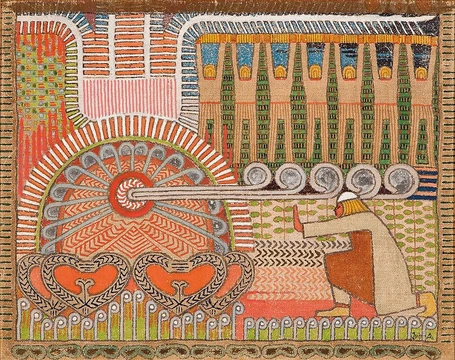
Broteas
Hunter who carved Cybele's image and burned himself.

Wikipedia / Wikimedia Commons
Broteas (from the Ancient Greek for "mortal" or "man") appears in Greek mythology as a hunter and the son of Tantalus—by either Dione, Euryanassa, or Eurythemista—making him brother to Niobe and Pelops. He was also counted among the Lapiths and died in their battle against the centaurs.
The central myth about Broteas involves his death by fire. A famous hunter, he refused to honor Artemis and boasted that flames could not harm him. In response, the goddess drove him mad, and he built a pyre and burned himself alive as a propitiatory sacrifice. This story has been compared to that of the hunter Actaeon, whose death was also framed as divine retribution. Broteas had a son named Tantalus, after his own father. A fragmentary Hesiodic papyrus from Oxyrhynchus links Dardanus, Broteas, and Pandion in a tradition otherwise unattested.
In antiquity, Broteas was also credited with carving a famous rock relief near Magnesia ad Sipylum. This ancient carving, believed to be the oldest image of the Great Mother of the Gods (Cybele), was still considered sacred by the Magnesians in the time of Pausanias (2nd century CE). The sculpture was cut into the cliff face of the crag Coddinus, north of Mount Sipylus—whose daemon was sometimes named as Broteas' grandfather. In 1881, W. M. Ramsay identified this relief with the Manisa relief, still visible about 6–7 km east of modern Manisa, above the road. The figure, 8–10 meters tall, sits in a recess a hundred meters above the marshy plain near the village of Akpinar. The head has partly broken away from natural causes, but the seated form remains clear to a non-expert: the goddess wears a polos headdress and holds her breasts with her hands. Faint traces of four Hittite hieroglyphics were once visible on a squared section to the right of her head. The site dates to the second millennium BCE and is Hittite. Nearby, other sites traditionally linked to the House of Tantalus since antiquity—such as the tomb of Tantalus (later Christianized as "Saint Charalambos' tomb") and the "throne of Pelops" (a rocky altar)—are also Hittite. The Manisa relief has sometimes been confused with a nearby natural rock formation associated with Niobe, the "Niobe of Sipylus" (the "Weeping Rock"), also mentioned by Pausanias.
In Renaissance and later literature, Broteas is most often called "Brotheus" and described as a son of Vulcan who threw himself
- also_known_as
- Brotheus (in Renaissance literature)
- mythological_role
- Hunter, son of Tantalus, Lapith
- known_for
- Self-immolation as a sacrifice; carving the ancient image of Cybele
- associated_figures
- Tantalus (father), Niobe (sister), Pelops (brother), Tantalus (son)
- notable_myth
- Refused to honor Artemis, bragged fire could not hurt him, driven mad and immolated himself
Lore & Background
In Greek mythology, Broteas was a hunter, son of Tantalus (by Dione, Euryanassa, or Eurythemista), and brother of Niobe and Pelops. He was also one of the Lapiths, killed at the battle of the Lapiths and the centaurs. The mythic rationale for his death states that he was a famous hunter who refused to honor Artemis and bragged that fire could not hurt him; Artemis then drove him mad, causing him to immolate himself on a pyre as a propitiating sacrifice. He can be compared to the hunter Actaeon, whose sacrifice is also justified as retribution. Broteas had a son named Tantalus, like his grandfather. A Hesiodic papyrus fragment from Oxyrhyncus connects Dardanus, Broteas, and Pandion, in a tradition of which there is no further evidence.
Broteas was also credited in antiquity with carving the most ancient image of the Great Mother of the Gods (Cybele) into the rock-face of the crag Coddinus, north of Spil Mount (Mount Sipylus), near the town of Magnesia ad Sipylum. This rock-cut carving, identified with the Manisa relief in 1881 by W. M. Ramsay, is still visible above the road about 6 or 7 km east of Manisa. The figure, 8–10 metres high, sits in a recess in a cliff-face a hundred metres above the marshy plain near the village of Akpinar. The goddess wears a polos headgear and holds her breasts with her hands; vague traces of four Hittite hieroglyphics could be seen to the right of her head. The site is Hittite, second millennium BCE. Nearby, other archaeological sites traditionally associated with the House of Tantalus since Antiquity are also Hittite.
Reader's Guide
Broteas occupies a dual role in classical tradition: as a mythological figure whose self-immolation served as a cautionary tale against hubris, and as a legendary artist credited with a monumental rock carving that survives to the present day. The Manisa relief, identified as the image of Cybele he was said to have carved, is a Hittite artifact from the second millennium BCE, demonstrating how ancient Greeks attributed pre-existing monuments to figures from their own mythology. This blending of myth and archaeology highlights the way later cultures interpreted and appropriated older sites. In Renaissance literature, Broteas was most often called 'Brotheus' and described as a son of Vulcan who cast himself into flames because of his deformity, a version derived from Ovid's curse poem Ibis. The Italian humanist Domizio Calderini used the name 'Brotheus' as a pseudonym for his literary rivals, helping to establish this variant in 15th–18th century works, including Natalis Comes' Mythologiae and Robert Burton's The Anatomy of Melancholy. The persistence of the Brotheus variant in early modern dictionaries and poetry shows how a minor mythological figure can be reshaped by later literary and scholarly traditions, while the original Greek myth remains tied to the landscape of western Anatolia.
Did You Know?
- Broteas was also one of the Lapiths, killed at the battle of the Lapiths and the centaurs.
- The Manisa relief, identified as Broteas' carving of Cybele, is a Hittite site from the second millennium BCE.
- In Renaissance literature, Broteas is most often called 'Brotheus' and described as a son of Vulcan who cast himself into flames because of his deformity.
- A Hesiodic papyrus fragment from Oxyrhyncus connects Dardanus, Broteas, and Pandion, in a tradition of which there is no further evidence.
Frequently Asked Questions
Who is Broteas?
Broteas is a figure from Greek mythology identified as a hunter and a son of Tantalus, making him a brother to both Niobe and Pelops. His name derives from the Ancient Greek word meaning "mortal" or "man."
What role does Broteas play in Greek myth?
He is primarily known as a skilled hunter who was also counted among the Lapiths, the human tribe that clashed with the centaurs. Beyond his hunting, he is credited with carving the ancient cult image of the goddess Cybele.
How does Broteas's story end?
After refusing to honor Artemis and boasting that fire could not touch him, the goddess drove him into a madness. In that state, he built a pyre and immolated himself as a propitiatory sacrifice.
Why is Broteas important in the mythological canon?
His tale serves as a cautionary example of hubris directed at a deity, and his self-immolation has been compared by scholars to other hunter myths involving sacrificial death. He also anchors the Tantalus family tree, linking him to well-known figures like Pelops and Niobe.
What is Broteas's connection to Cybele?
He is credited with carving the ancient cult statue of Cybele, a major mother goddess in Greek and Anatolian religion. This act ties him to sacred image-making beyond his more famous role as a hunter.
More in Mythological hunters 1-24
Spotted an error? Know more?
This is a living reference — every entry is fact-audited, and reader corrections feed straight into our audit queue. Suggest an edit · See this site's audit record