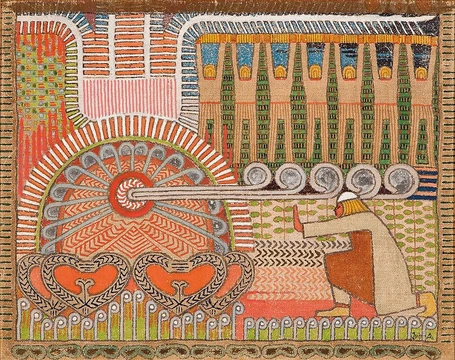
Hoori
God of grain and grandfather of Emperor Jimmu.
Hoori (火折), also known as Hikohohodemi no Mikoto (彦火火出見尊) and Yamasachihiko (山幸彦), is a god in Japanese mythology. He is the third and youngest son of Ninigi and Sakuyahime, and is one of the ancestors of the Emperors of Japan as the grandfather of Emperor Jimmu.
- field
- Japanese mythology
- nationality
- Japanese
- known_for
- Ancestor of the Emperors of Japan; god of cereals or grain; central figure in the lost fish-hook legend
Lore & Background
Hoori's legend is told in both the Kojiki and the Nihon Shoki. He was a hunter who had an argument with his elder brother Hoderi, a fisherman, over a fish-hook that Hoori had forced his brother to lend him and had lost. Hoderi refused to accept another hook due to the belief that each tool is animated and unique. Hoori descended to the bottom of the sea to search but instead found Toyotamahime, daughter of the sea god Ōwatatsumi. Ōwatatsumi helped Hoori find the lost hook, and Hoori later married Toyotamahime.
Hoori lived with his wife in a palace under the sea for three years, then became homesick and returned to his own country. His brother forgave him after he returned the hook. Toyotamahime gave birth to a son named Ugayafukiaezu. During childbirth, she had Hoori swear not to see her real figure, but he broke his promise and discovered her true form was a Wani. She returned to her father, never to return. Ugayafukiaezu later married Toyotamahime's younger sister Tamayorihime, who raised him, and they gave birth to Emperor Jimmu, the first Emperor of Japan.
Reader's Guide
Hoori is significant in Japanese mythology as a key ancestral figure linking the heavenly gods to the imperial line. As the grandfather of Emperor Jimmu, he is part of the Three Generations of Hyūga, a period between Tenson Kōrin and Jimmu's Eastern Expedition. His story, preserved in both the Kojiki and Nihon Shoki, illustrates themes of brotherly conflict, loss, and reconciliation, as well as the sacred nature of tools. Hoori is worshiped mainly as a god of cereals or grain. The 'ho' (火) in his name is often associated with fire, but etymologically it derives from a different character 'ho' (穂) meaning crops, particularly rice. 'Ori' (折り) means to bend, indicating a crop so rich it bends under its own weight. His alternate name Hohodemi means many harvests. His legend also includes the motif of a forbidden sight, common in Japanese folklore, and the transformation of his wife into a Wani (a dragon-like creature). Hoori's legacy endures as a symbol of agricultural abundance and as a foundational figure in the imperial mythology of Japan.
Did You Know?
- Hoori is also known as Yamasachihiko (山幸彦).
- He is the grandfather of Emperor Jimmu, the first Emperor of Japan.
- His wife Toyotamahime was the daughter of the sea god Ōwatatsumi.
- The 'ho' in his name etymologically refers to crops, especially rice, not fire.
More in Mythological hunters 1-24
Spotted an error? Know more?
This is a living reference — every entry is fact-audited, and reader corrections feed straight into our audit queue. Suggest an edit · See this site's audit record